Build Your
Audience.
Be known by the people who buy from you, in your own words, run from ChatGPT or Claude. Unzip it, upload two files to a Claude chat (or open the folder in Claude Code or Codex) and say "Let's build my audience." How I grew my account by telling true stories, my tools and 21 guides.
Instant download · Works, or your money back · Secure checkout with Stripe
Buy on your phone, set up on your computer. The booklet reads anywhere.
- £20 once
- Works with ChatGPT or Claude
- Yours to keep
- No subscription
Can you just write me a month of posts?
No, and you wouldn't want what I'd write. I wasn't there when that client rang you at 6.40 on a Friday. You were. Tell me about it, out loud.
Nobody had been paid. Twelve staff. I found it in nine minutes and paid them myself that night.
That's a post. Here it is in your words, cut by a third, with three first lines taken from what you just said. Read it out loud and change anything you wouldn't say. You post it.
Is this for you?
It's for you if
- You know you should post on LinkedIn, but you never know what to say.
- You've posted before and it felt like shouting into a room nobody was in.
- You want the people who buy from you to know who you are, in your own words.
- You've never posted at all. There's a route for you that starts with one true story.
It's not for you if
- You want someone to post for you. It never posts, and it won't write as you without you.
- You want followers for their own sake. This is about being known by the people who buy.
You'll need
- A computer or a phone.
- A Claude or ChatGPT account. A free one works the guide-and-spreadsheet way.
- About 30 minutes for the first session.
It won't write your posts. It gets them out of you.
People can taste a post a machine wrote. So this works the way I do: your stories, your words, checked and planned, posted by you.
You tell it what happened.
Out loud or in rough notes. It asks the questions a good editor would: when, who, what it cost, what you'd tell someone in the same spot.
It shapes it and checks it.
In order, a third shorter, your phrases kept, three first lines made from your own words. Then it flags walls of text and anything that reads machine-made.
You make it yours and post it.
Read it out loud, change what you wouldn't say, and post it by hand. It logs what went out and what it did, and tells you what's working.
Watch how it works.
Buy, download, upload two files to a Claude chat (or open the folder in Claude Code), and say one sentence. Forty-five seconds, start to finish.
Music: Ovanea by Moavii, from Free To Use.
This is what you get to look at.
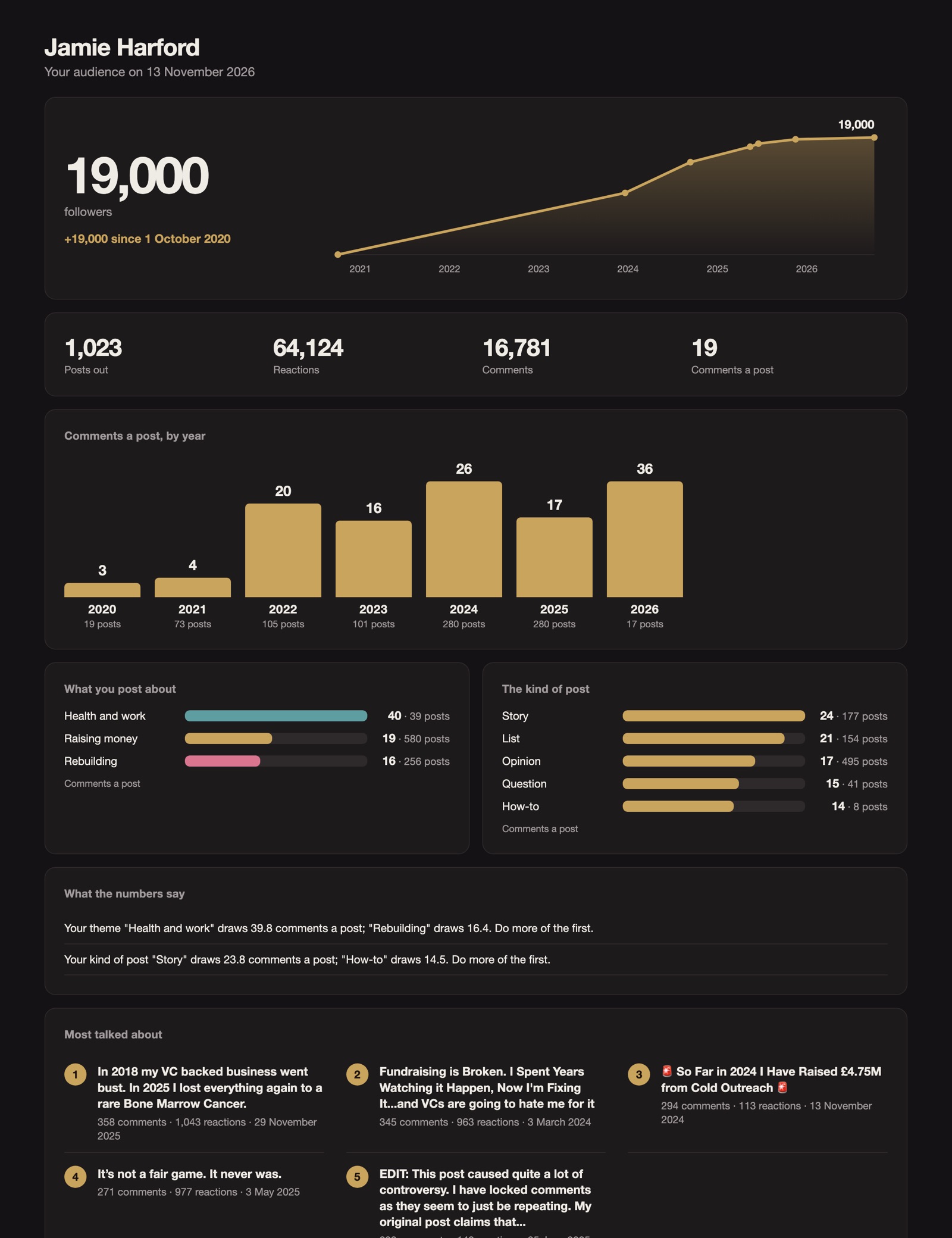
Real screens from the folder, run on my own account: every post I have written since 2020, more than a thousand, with the reactions and comments they really got, and my followers from zero to 19,000.
Jamie Harford  ·  Friday 13 November 2026
19,000 followers, +19,000 since 1 October 2020. Last counted 40 days ago: count again.

1. Today's post
   Nothing planned for today. Next: Mon 16 Nov p-1024 (Story, drafted).

2. Replies to give (0)

3. People to comment on (0 done today, 0 to go)
   Nobody on your list yet. Add the people you want to notice you: python3 audience.py person --name "..."

4. Numbers to log (0)

5. Enquiries open (0)

This week: 0 of 0 posts out, 0 comments left on other people's posts. Ideas in the bank: 0.
Drafts: 1 waiting for your yes, 0 approved.
2026-11-16-p-1024.md  (draft)
  110 words, 677 characters, first line 128 characters
  First line: In today's fast-paced world, every entrepreneur faces setbacks — but it's not just about failing, it's about how you rise again.
  STOP  there are still [brackets] to fill in: [Add the number: what the investment was and what it became.]
  look  the first line is 128 characters. Over about 110 it's cut off on a phone before anyone decides to read on.
  look  one paragraph runs to 66 words ("Back in 2018, I embarked..."). Break it up: most people read this on a phone.
  look  words people now read as machine-written: game-changer, fast-paced, ever-evolving, evolving landscape, let that sink in, a journey. Say it the way you'd say it out loud.
  look  words you said you never use: game-changer.
  look  an "it's not just this, it's that" sentence. It's a pattern readers have learned to skip.
  look  1 long dash (—). Use a full stop or a comma.
  look  4 hashtags. The playbook says none: they make a post look like an advert and add nothing on LinkedIn now.
  look  the first line has no number, no person and no year in it. One of those usually makes people stop.
Six stages. Start anywhere.
From "what would I even say?" to messages that start "I've been reading your posts". Got a story today? It starts there.
The point
What you sell, who should know you, three things to be known for, and a pace you can keep in your worst month.
Your voice and stories
It reads your own past posts, measures how you write, and digs out the stories only you have. Twenty before you plan anything.
The shop front
A profile that tells a stranger who you are and why to listen in ten seconds, with your hardest day pinned.
The plan
Twelve weeks laid out on your days, rotating your themes and kinds of post, always one in hand.
The daily thirty
Today's post from story to your yes, replies to every comment, three useful comments on other people's posts.
Conversations
The people you want to notice you, every enquiry traced to the post that brought it, and a weekly read of what works.
Build Your Audience.
£20 once
This is the method I'd walk you through in an hour together, for you to run, for £20.
Instant download · Works, or your money back · Secure checkout with Stripe
Installs nothing · No tracking · Nothing sent to Nine Bar
A folder you keep. Pay with Stripe, download straight away, and we email you the link.
Want all six business playbooks? Get Start, Round, Grow, Audience, Save and App for £60. Or any three for £45, your choice.
Already bought it? Get your download link again.
- The booklet: every guide in one PDF, for your phone or to print
- The playbook: my method, from more than a thousand posts
- 21 guides, from first lines to the hard-day post
- The content planner spreadsheet
- The tracker, draft checker, carousel maker and dashboard
- My own account as the worked example
- Works with ChatGPT or Claude
What's in the folder.
The AI reads the playbook. These are yours: 21 guides in my voice, a spreadsheet and a worked example.

Start
Your voice and your stories
Posts
People and enquiries
You, the owner
Spreadsheets and the worked example
The playbook.
How I built an audience three times, the last from nothing in 2020 after I'd deleted every account I had. What works now, and what I've stopped doing.
The content tracker.
Runs in your chat or on your computer and never touches the internet: your plan, the ideas bank, the draft checker, your numbers, carousels and the dashboard.
The rules of the road.
What you may claim, whose stories you may tell and what the platforms forbid, in plain English.

"I used to think if you just did good work, people would find you. But they don't."
I'm not a celebrity and I haven't sold a business for a billion. I'm a business owner who tells true stories. When my business failed in 2018 I deleted everything and said nothing for two years. In October 2020 I started again from zero and just wrote what happened: the wins, the losses, the lessons. More than a thousand posts later, 19,000 people follow them. That's the whole method, and it's in this folder.
Jamie Mussett Harford
The rules it keeps for you.
No hacks. "There are no hacks, just consistency, intention and time in the game".
Your words, not its words.
It interviews, shapes and checks. You rewrite until it sounds like you. Nothing is approved without your yes.
You post by hand.
No bots, no automatic comments, no pods, no bought followers. It has no connection to any platform.
Nothing made up.
No invented stories, customers, results or numbers. Every post starts from something that happened to you.
Your data stays yours.
Everything is kept in the folder on your computer. Nothing is sent to Nine Bar.
Questions people ask.
Who is it for?
Business owners, founders and consultants who want the people they sell to, hire or raise from to know who they are. It is written for LinkedIn, where I built mine, and the method works on any platform. You don't need any followers to start.
Will it write my posts for me?
No, and that's the point. It gets the story out of you, puts it in order, cuts it, offers first lines made from your own words and checks it. You rewrite it until it sounds like you. Posts written by a machine sound like one, and readers can tell.
Does it post for me, or connect to LinkedIn?
No. It has no connection to any platform and never will. You post, comment and message by hand. Automation is against the platforms' rules and it's how accounts get closed.
What do I need?
Easiest in a Claude chat, with nothing to install: you upload two files from the folder to start (a guides file when it asks) and it keeps your plan, checks your drafts and draws the dashboard. Also ChatGPT Plus, or Claude Code and Codex if you use them. On free ChatGPT, Gemini or Copilot it works the guide-and-spreadsheet way: the same method, with the big sums in the spreadsheet and no dashboard.
Is it safe to open and run?
Yes. Nothing in the folder installs anything, runs on its own or sends anything to anyone. It holds guides, spreadsheets with no macros, PDFs and one small Python script, audience.py, that uses only what comes with Python. It never goes online and has no link to your bank, your email or anyone else. Nothing is ever sent to Nine Bar: no accounts, no tracking. In a chat, what you upload is read by that AI company, so don't upload passwords or card numbers. You can open the script in any text editor and read every line, and the folder includes a page that lists exactly what it does.
I've never posted. Is it too late?
I started again from zero in October 2020 after two years of saying nothing. The first three months are quiet for everyone. The folder plans for that, and tells you what to look at so you don't give up in week five.
How much time does it take?
Thirty minutes a working day: ten on today's post, five on replies, ten on other people's posts, five on your numbers. Two or three posts a week is plenty.
Can it guarantee followers or clients?
No one honestly can. It gives you the method I use, the discipline to keep at it and a weekly read of what's actually bringing people to you.
Can I get a refund?
If it won't open or run on your computer, yes. Email Jamie within 30 days of buying: we'll help you get it working, and if we can't, we refund you in full. We don't refund a change of mind, because the download is yours the moment you pay.
Rather have me in it with you?
Build Your Audience is the do-it-yourself version.
The Pressure Call
1 hour
Sixty minutes with me on your profile, your themes and your first posts, and a written plan for the next thirty days.
What's includedGrow Your Business
£20
When the audience is arriving: your offer, your price, your pipeline and the follow-up that turns readers into customers.
See Grow Your BusinessRun Your Own Round
£20
Raising money? Investors look you up before they reply. The playbook for the round itself.
See Run Your Own Round