Run Your
Own Round.
Your funding round, run from ChatGPT or Claude. Unzip it, upload two files to a Claude chat (or open the folder in Claude Code or Codex) and say "Let's run my round." My method, my tools and 25 guides, built on 150+ rounds and £130M raised alongside founders.
Instant download · Works, or your money back · Secure checkout with Stripe
Buy on your phone, set up on your computer. The booklet reads anywhere.
- £20 once
- Works with ChatGPT or Claude
- Yours to keep
- No subscription
Let's run my round.
Good. Five questions first. What does the business do, and who pays you for it?
We bake bread and coffee for 1,500 customers a week. I want £150,000 to open a second shop.
That's ten tickets of £15,000, or six of £25,000. Six is easier to fill. Who already knows you and has money? Start there: five people a day. I'll draft, you approve, nothing goes without your yes.
Is this for you?
It's for you if
- You're raising your first or second round, from friends and family up to a seed round.
- You'd rather run it yourself than pay a fee or hand over equity to someone who raises for you.
- You need the model, the deck and a list of investors who already know you, in that order.
- You want a daily list of who to follow up, not another spreadsheet you forget about.
It's not for you if
- You want someone to raise the money for you. This helps you do it yourself.
- You haven't started trading or found your customer yet. Start Your Business comes first.
You'll need
- A computer or a phone.
- A Claude or ChatGPT account. A free one works the guide-and-spreadsheet way.
- About 30 minutes for the first session.
- Sending emails from your own mailbox needs Claude Code or Codex on a computer. Everything else works in a chat.
Upload two files. Say one sentence.
No platform, no login, no subscription. It works with the AI you already use.
Download the folder.
Pay once and download straight away. Put the folder somewhere you'll keep it. Your round lives inside it, on your own computer.
Open it in ChatGPT or Claude.
In Claude Code or ChatGPT's Codex, choose the folder and the AI reads the playbook by itself. In a Claude chat, upload the tool and the core file from the for-a-chat folder, and a guides file when it asks: nothing to install.
Say "Let's run my round."
It starts from what your AI already knows about your business, checks it with you, and builds the rest from scratch. Then you get your next three jobs with dates.
Watch how it works.
Buy, download, upload two files to a Claude chat (or open the folder in Claude Code), and say one sentence. Forty-five seconds, start to finish.
Music: Ovanea by Moavii, from Free To Use.
This is what you get to look at.
Real screens from the folder. The round shown is the worked example that comes with it: a fictional bakery, four weeks in.
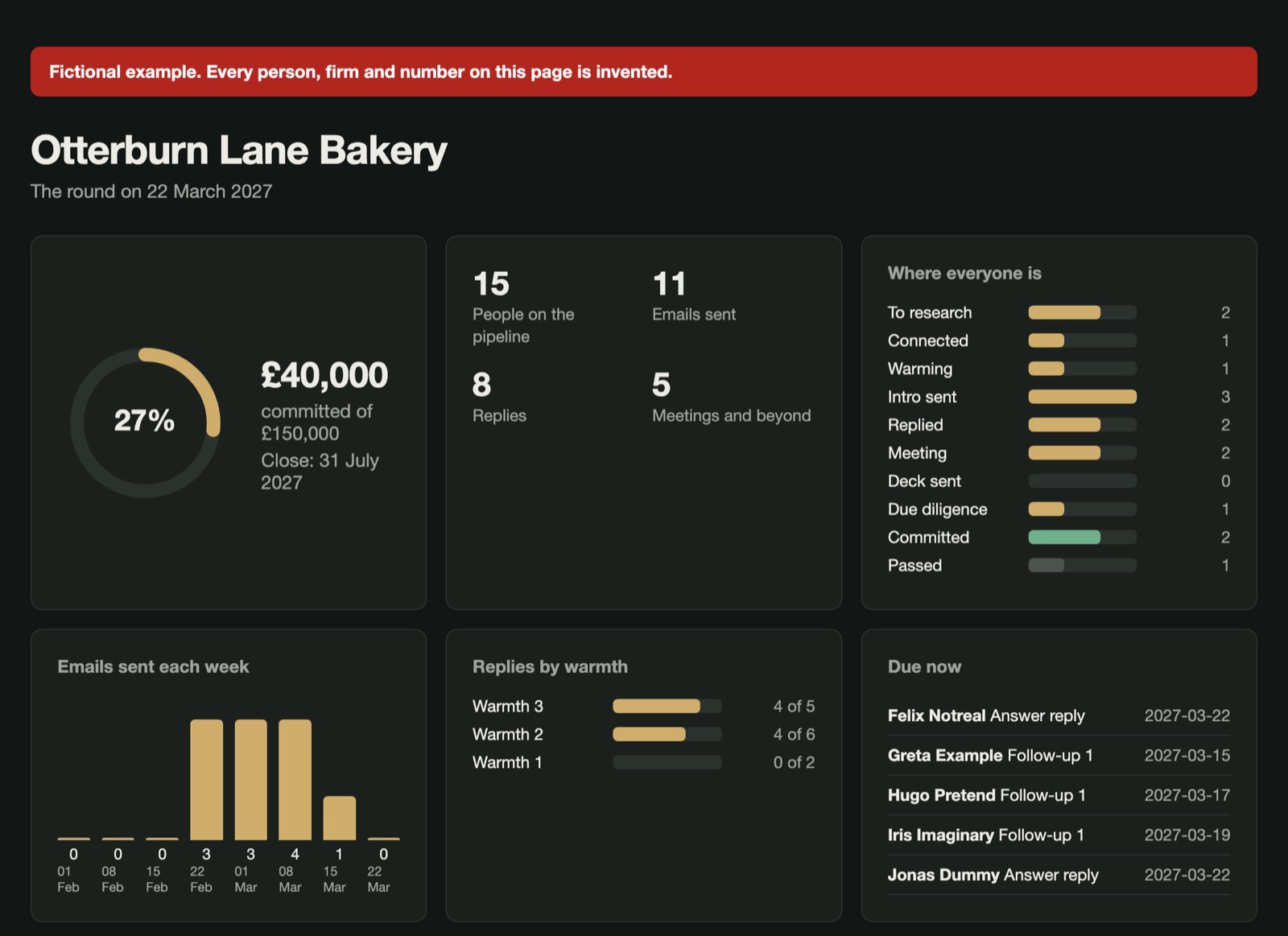


*** FICTIONAL EXAMPLE: every person, firm and number here is invented. ***
Otterburn Lane Bakery  ·  Monday 22 March 2027
Committed £40,000 of £150,000 (27%). Close 2027-07-31.

1. Replies to answer (3)
   clara-fictional        Fictional Family Office
   felix-notreal          Notreal Dental
   jonas-dummy            Dummy & Co Accountants

2. Follow-ups due (3)
   greta-example          Follow-up 1  last contact 2027-03-08
   hugo-pretend           Follow-up 1  last contact 2027-03-10
   iris-imaginary         Follow-up 1  last contact 2027-03-12

3. Next five people
   nell-template          warmth 3  email, message 1               Our flour supplier
   otto-demo              warmth 2  email, message 1               Customer; runs a building firm in Leeds

Drafts: 2 waiting for your yes, 1 approved and ready to send.
This week: 1 email sent. Pipeline: To research 2, Connected 1, Warming 1, Intro sent 3, Replied 2, Meeting 2, Due diligence 1, Committed 2, Passed 1.

Six stages. Start anywhere.
From "should I raise?" to money in the bank. Got a term sheet already? Jump straight to the close.
Ready
Should you raise at all? Which money fits, exactly how much, and the round shaped so it can close: fixed tickets, a name, a deadline.
The numbers
A 24-month model with every assumption sourced. Runway, break-even, and the three tests an investor will run on you.
The deck
A designed twelve-slide deck in the order investors read, with your best traction number on the cover and up front in everything you send. Drop in eight of your own pictures, save it as a PDF.
Your investors
Your own network sorted into a scored pipeline. Then new names, researched one by one. No bought lists.
The daily thirty
Replies first, follow-ups due, five new people. It drafts, you make it yours, you send it (from your own mailbox automatically in Claude Code or Codex).
The close
The data room, due diligence answers, the term sheet read clause by clause with my red flags.
Run Your Own Round.
£20 once
Retained Advisory is me beside you until the round closes. This is the same method, for you to run, for £20.
Instant download · Works, or your money back · Secure checkout with Stripe
Installs nothing · No tracking · Nothing sent to Nine Bar
A folder you keep. Pay with Stripe, download straight away, and we email you the link.
Want all six business playbooks? Get Start, Round, Grow, Audience, Save and App for £60. Or any three for £45, your choice.
Already bought it? Get your download link again.
- The booklet: every guide in one PDF, for your phone or to print
- The playbook: my method, start to close
- 25 guides, from the message library to the term sheet decoder
- Three spreadsheets, including the round calculator
- The round tracker, deck maker and dashboard
- A worked example round to copy from
- Works with ChatGPT or Claude
What buyers said.
Word for word.
“Jamie's playbooks are a gamechanger.”
What's in the folder.
The AI reads the playbook. These are yours: 25 guides in my voice, three spreadsheets and a worked example.

Start
Investors and outreach
Deck and numbers
Diligence and the close
You, the founder
Spreadsheets and the worked example
The playbook.
My strategy for raising money, from six years of teaching it in public: what works now, the mistakes, and what I've stopped recommending.
The round tracker.
Runs in your chat or on your computer: your pipeline, reply checking, the model, the deck and the dashboard, plus sending from your own mailbox in Claude Code or Codex.
The rules of the road.
Who you can legally send a deck to in the UK, EU and US, and the email and privacy rules, in plain English.

"No investor will take you seriously if you treat them like an outbound prospect."
I've worked on more than 150 funding rounds and raised £130M alongside founders. I've also turned £250,000 of investment into £0. Both are in this folder. It works the way I make clients work: relationships, not volume. Five people a day. Thirty minutes. Every message written for one person.
Jamie Mussett Harford
The rules it keeps for you.
Investors can tell a mail merge in a second. So the round desk keeps the rules I hold clients to.
Nothing goes without your yes.
Every message waits for you to read it, change it and approve it.
One person at a time.
One recipient per email, from your real address. No tracking, no mail merge, no bought lists. LinkedIn is always by hand.
No chasing.
Two follow-ups at most, each with something new, then it stops. Anyone who asks to stop is never contacted again.
Your data stays yours.
Everything is kept in the folder on your computer. Nothing is sent to Nine Bar.
Questions founders ask.
What do I need?
Easiest in a Claude chat, with nothing to install: you upload two files from the folder to start (a guides file when it asks) and it tracks your round, builds the model and the designed deck, and draws the dashboard. Also ChatGPT Plus, or Claude Code and Codex if you use them. On free ChatGPT, Gemini or Copilot it works the guide-and-spreadsheet way: the same method, with the big sums in the spreadsheet and no dashboard. Sending from your own mailbox needs Claude Code or Codex; everywhere else it writes each email and you press send.
Is it safe to open and run?
Yes. Nothing in the folder installs anything, runs on its own or sends anything to anyone. It holds guides, spreadsheets with no macros, PDFs and one small Python script, round.py, that uses only what comes with Python. It never goes online, except one thing you choose: on your own computer, in Claude Code or Codex, it can send email from your own mailbox using an app password you create and can cancel. Nothing is ever sent to Nine Bar: no accounts, no tracking. In a chat, what you upload is read by that AI company, so don't upload passwords or card numbers. You can open the script in any text editor and read every line, and the folder includes a page that lists exactly what it does.
Do I have to explain my business from the start?
No. It first looks at what your AI already has: its memory of you, your project files, any documents you've connected, and your existing deck or accounts if they're there. It tells you what it found, asks you to confirm it, and only asks about what's missing. If there's nothing, it builds the picture with you in five questions.
I'm not technical. Can I use it?
Yes. The easiest way is a Claude chat: upload two files to start, a guides file when it asks, and talk in plain English. The START HERE page in the folder walks you through it in five minutes, and every resource opens in your browser like a web page.
Will it email investors on its own?
No. Every message waits for your yes on that exact message. In Claude Code or Codex it sends from your own address, one person at a time, at a steady pace, and stops following up the moment someone replies.
Does it include an investor list?
No. It builds your list from your own network first, then helps you research new names properly. If you want me alongside you while you raise, that's Retained Advisory.
Where does my data go?
It stays in a folder on your computer. Nothing is sent to Nine Bar. Your email password is typed into your own computer, never into a chat.
Can it guarantee I'll raise?
No one honestly can. It gives you the method I use, the discipline to run it every day, and a straight read of whether your round is working after eight weeks.
Can I get a refund?
If it won't open or run on your computer, yes. Email Jamie within 30 days of buying: we'll help you get it working, and if we can't, we refund you in full. We don't refund a change of mind, because the download is yours the moment you pay.
Rather have me in it with you?
Run Your Own Round is the do-it-yourself version. When you want me alongside you, there's more.
Retained Advisory
2 calls a month
Me beside you for as long as the round takes: the model, the deck, the investor conversations and the negotiation. Two calls a month and WhatsApp in between.
See Retained AdvisoryYour pitch deck, written
100+ decks so far
Twelve plain slides and a model that holds up, written and designed with you. It starts with a free WhatsApp chat, in any language.
How it works